SAP Human Capital Management for Smarter HR Operations
More change and disruption have occurred in the last few years in modern HR operations than in the previous two decades combined.
However, the fundamental goals of human capital management, or HCM, are still the same. These goals include payroll, onboarding, training, and recruitment. The need for HR departments to become hubs of business innovation, providing data-driven insights and analytics across all worldwide operations, is rapidly evolving.
The way your teams operate and how employers and employees interact with one another and their professions has undergone significant changes, much of which is due to the efforts of today’s HR departments.
So here we will look into Importance of SAP Human Capital Management
SAP & modules
SAP (Systems, Applications, and Products) is a leading ERP software that integrates various business functions, simplifies operations. Key SAP modules include SAP ERP, which centralizes financial and operational processes; SAP FICO for comprehensive financial accounting and controlling; and SAP MM, which manages procurement and inventory efficiently.
Additional modules such as SAP CRM focus on customer relationships, sales, and marketing. SAP SCM optimizes supply chain management, including procurement and logistics, and SAP HCM manages HR functions like recruitment and payroll.
Understanding SAP Human Capital Management (SAP HCM)
SAP HCM (SAP Human Capital Management) is a crucial SAP module designed to enhance the efficiency of business management structures. It offers essential functionalities for managing talent, processing employee payments, handling applicant tracking, and overseeing talent training, effectively serving as a replacement for SAP HR.
This module integrates multi-level application and approval processes with personnel management, embedding automation within the organizational hierarchy. By connecting various submodules, SAP HCM enables organizations to tailor their systems to address specific business needs.
Human capital management (HCM) encompasses a wide range of practices and applications used for recruiting, managing, and developing an organization’s workforce.
For core HR and payroll operations, time and attendance management, talent development, employee experience management, and analytics, the SAP Human Capital Management suite offers a wide range of cutting-edge, strategic capabilities. These products are made to assist companies in changing their workforces and accomplishing their business objectives.
Importance of SAP Human Capital Management
- Automation: Automates regular HR duties to cut down on errors and administrative work.
- Engagement: Performance management and career development tools help to keep employees engaged and motivated.
- Analytics: Advanced analytics and reporting capabilities are provided by analytics, allowing firms to make personnel decisions based on data.
- Recruitment: Aids in the efficient hiring and onboarding of top personnel by facilitating these processes.
Key Components of SAP HCM
The following are the Key Components of the SAP Human Capital Management:

1. Personnel Administration (PA)
Personnel Administration serves as the core of all human capital management activities within SAP HCM. It maintains the “digital personnel file,” which replaces traditional paper-based records by consolidating all personnel data into a single, up-to-date source. This digital file includes a range of information, from basic employee details such as personnel number, name, and address, to more specific data like organizational unit (department), pay scale, and pay scale group.
Each piece of data in the personnel master record is associated with a validity period. This feature ensures that changes are transparent and traceable, providing a clear timeline of personnel data modifications. A noteworthy sub-module within Personnel Administration is Personnel Cost Planning and Simulation (PA-CP). PA-CP supports comprehensive and systematic personnel management by allowing organizations to plan and simulate personnel costs effectively.
2. Personnel Time Management (PT)
Personnel Time Management is crucial for accurate employee time tracking across various sectors. This can be achieved through manual documentation by employees or via automated time-recording terminals. Many organizations also employ time administrators who manually update or correct time records.
To maximize automation, it is recommended to use time-recording terminals or similar technologies. Time postings are then transferred to the SAP system via interfaces, forming the basis for subsequent processes such as payroll accounting. SAP HCM also offers browser-based time recording for employees working remotely or outside the business premises. The system supports traditional staff time management tasks such as requests for flexible working days, time supplements, and corrections.
3. Payroll Accounting (PY)
Payroll Accounting is a critical component of Personnel Administration in SAP HCM. It encompasses essential elements such as pay groups, working hours, various absence times, flexible salary components, and special payments. These elements are streamlined to optimize payroll processes.
SAP HCM continuously updates Payroll Accounting to comply with regulatory standards and incorporate business innovations. The system allows for simulation runs, which provide additional security by enabling the identification and correction of errors before final processing. Additionally, SAP HCM PY supports multiple payroll periods, which is particularly beneficial for multinational corporations (MNCs) with complex payroll requirements.
4. Organizational Management (OM)
Organizational Management in SAP HCM is designed to model the entire enterprise structure, including its organizational units. This module provides tools for process organization analysis and personnel analysis, facilitating effective personnel planning.
SAP HCM OM is instrumental in planning and managing organizational changes. It also serves as the foundation for career guidance and applicant management, supporting the strategic development and organization of the workforce.
5. Personnel Development (Talent Management)
In SAP HCM, talent management focuses on aligning vacant positions with the qualifications and interests of existing employees. The system evaluates and matches employee capabilities with available roles based on predefined criteria.
Talent management also supports employees in setting and achieving career development goals. These goals and the related agreements are tracked and managed within the system, ensuring alignment between employee aspirations and organizational needs.
6. Training and Event Management (PE)
Training and Event Management is closely linked with Personnel Development in SAP HCM. This module facilitates the planning, execution, and evaluation of training and educational events.
The system enables the creation and management of an event catalog, which includes lectures, room bookings, and documentation. It supports the use of event templates and the scheduling of recurring events. Additionally, SAP HCM PE allows for cost center assignments and billing, integrating these aspects seamlessly with personnel training records.
A valuable feature of SAP HCM PE is its ability to transfer qualifications directly to HR master data. This integration allows for automatic retrieval of each employee’s training record, enhancing the management and tracking of employee development.
7. Recruitment (PB)
The Recruitment component of SAP HCM simplifies the process of managing job vacancies. It allows for the posting of job requirements and descriptions on various online platforms. The module also supports automation of functions such as scheduling interviews and application deadlines, enabling efficient tracking and management of the recruitment process.
Recruitment within SAP HCM provides candidates with access to a separate set of master data management features. This facilitates the creation of a candidate pool and simplifies the transfer of applicant information to the HR master data once a candidate is hired, ensuring a smooth transition from application to employment.
Benefits of SAP HCM for Organizations
SAP HCM (Human Capital Management) automates a lot of functions to assist businesses optimize their HR procedures. By doing away with manual labor, HR operations become more productive and efficient.
With SAP HCM, companies can easily manage different types of employees, such as permanent staff, part-time workers, or daily wage earners. The software also integrates smoothly with existing systems, so organizations don’t need to completely overhaul their processes when adopting SAP HCM.
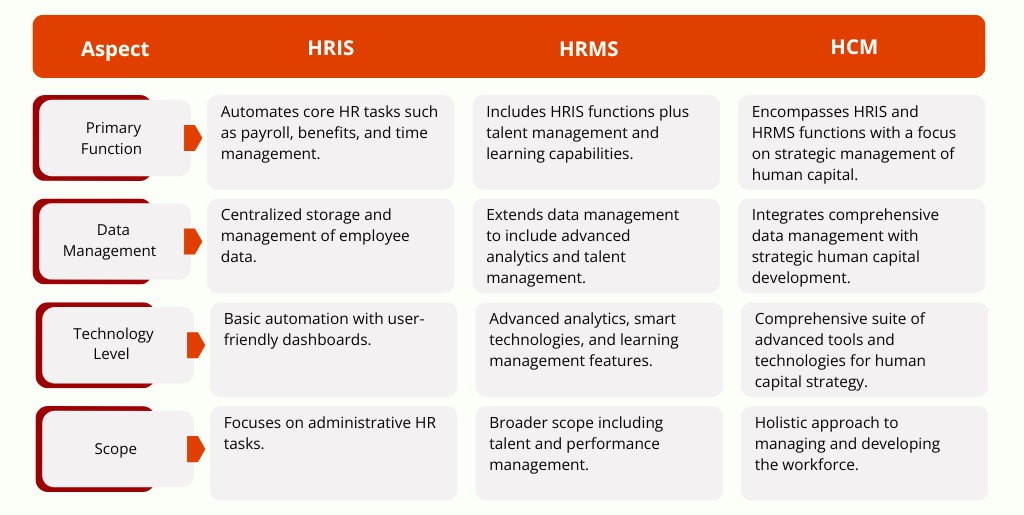
HRIS (Human Resources Information System) VS HRMS (Human Resources Management System) VS HCM (Human Capital Management)
Future of SAP HCM: SuccessFactors
The most recent version of SAP S/4HANA software no longer includes SAP HCM. On the other hand, businesses who used HCM in conjunction with other modules before can still switch to SAP S/4HANA. Compatibility Packs enable this while simultaneously providing normal SAP S/4HANA functionality. But it’s important to remember that Compatibility Packs are limited to use until the end of 2025.
Businesses who are unable or unwilling to use the cloud-based SuccessFactors now have an option available to them. Under the name “SAP HCM for S/4HANA,” it will be accessible starting in 2023. This system will not be integrated with SAP S/4HANA, in contrast to ERP 6.0. It needs to run on a sidecar, which is a different server.
The solution’s functional scope will be somewhat comparable to that of SAP HCM as it exists today. It is also anticipated that there will be minimal support for this compromise option. Current projections indicate that it will end around 2030. In the long run, there is no way to avoid integrating SAP SuccessFactors if nothing changes with this approach.
Conclusion
Personnel management faces key challenges today, including a shortage of skilled labor, inefficient position filling, and time-consuming payroll tasks. SAP HCM, with its SuccessFactors solution, addresses these issues by digitalizing and automating HR functions. Its flexible reporting and analytics capabilities also optimize strategic HR decisions.
Contact us to know more about SAP or SAP S/4HANA!
FAQ’s
1. What is SAP Human Capital Management (HCM)?
SAP HCM is a suite of tools that helps organizations manage their workforce, including hiring, payroll, and employee development.
2. Why is SAP HCM important for businesses?
It streamlines HR processes, improves data accuracy, and enhances employee satisfaction and productivity.
3. What key functions does SAP HCM cover?
Recruitment, payroll, performance management, learning and development, and employee self-service.
4. How does SAP HCM support employee development?
Through learning management systems, performance tracking, and career development tools.