Why Distributors Need a Digital Moat for E-commerce Today
Every distributor has faced the same challenge. You put in the effort to win a new customer, only to watch them leave a few months later when a competitor offers a slightly lower price. The battle never ends, and in a world where anyone can launch a polished online store overnight, keeping customers loyal feels harder than ever.
What many distributors do not realize is that the most successful players are not only competing on price or speed. They are quietly building something much stronger, a digital moat for e-commerce. This moat is not about locking customers in with contracts. It is about creating digital experiences and tools that become so valuable to buyers that leaving would feel like losing part of their daily routine.
Want to know how some distributors have turned their portals into the kind of moat that protects revenue, drives loyalty, and keeps competitors at bay? Let’s dive in.
What is a Digital Moat for E-Commerce?
To truly understand why this matters, you first need to know what a moat looks like in the digital world.
A digital moat for e-commerce is a set of customer facing tools and integrated workflows that make your platform the easiest place for buyers to plan, purchase, and manage their operations. It naturally raises switching costs because leaving you means losing dashboards, history, automations, and insights that make the buying process easier.
What a Digital Moat Looks Like
A true digital moat is made up of tools and services that become part of your customer’s workflow, not just “extras” they can take or leave.
- Self-service portals that let customers view past orders, track shipments, and reorder with one click.
- Real-time inventory visibility so customers can plan ahead and avoid stockouts.
- Personalized dashboards showing purchase trends, costs, and suggested improvements.
- Predictive reorder systems that recommend when and what to buy based on usage patterns.
- Maintenance tracking tools for machinery, offering service reminders and repair kit suggestions.
When customers use these tools daily, they build habits and habits are hard to break.
Why Distributors Need a Digital Moat
- Commodities = thin margins: When most of what you sell looks similar to your competitor’s product, price becomes the default lever. But price wars erode margins fast.
- Low switching costs: Many buyers view distributors as interchangeable. If they can get similar stuff cheaper or faster, they will.
- Customer expectations rising: Buyers expect transparency, ease of ordering, real-time inventory, fast support. They expect more than just catalogs.
- Digital disruptors are gaining ground: New entrants, marketplaces, digitally native B2B platforms are using technology to reduce friction and gain customers. Traditional distributors must respond.
A digital moat for e-commerce provides defense: once a buyer is actively using your portal, dashboards, and reorder systems, they are less likely to leave you for a competitor offering only “same stuff, cheaper.”
Building Your Digital Moat: A Practical Roadmap
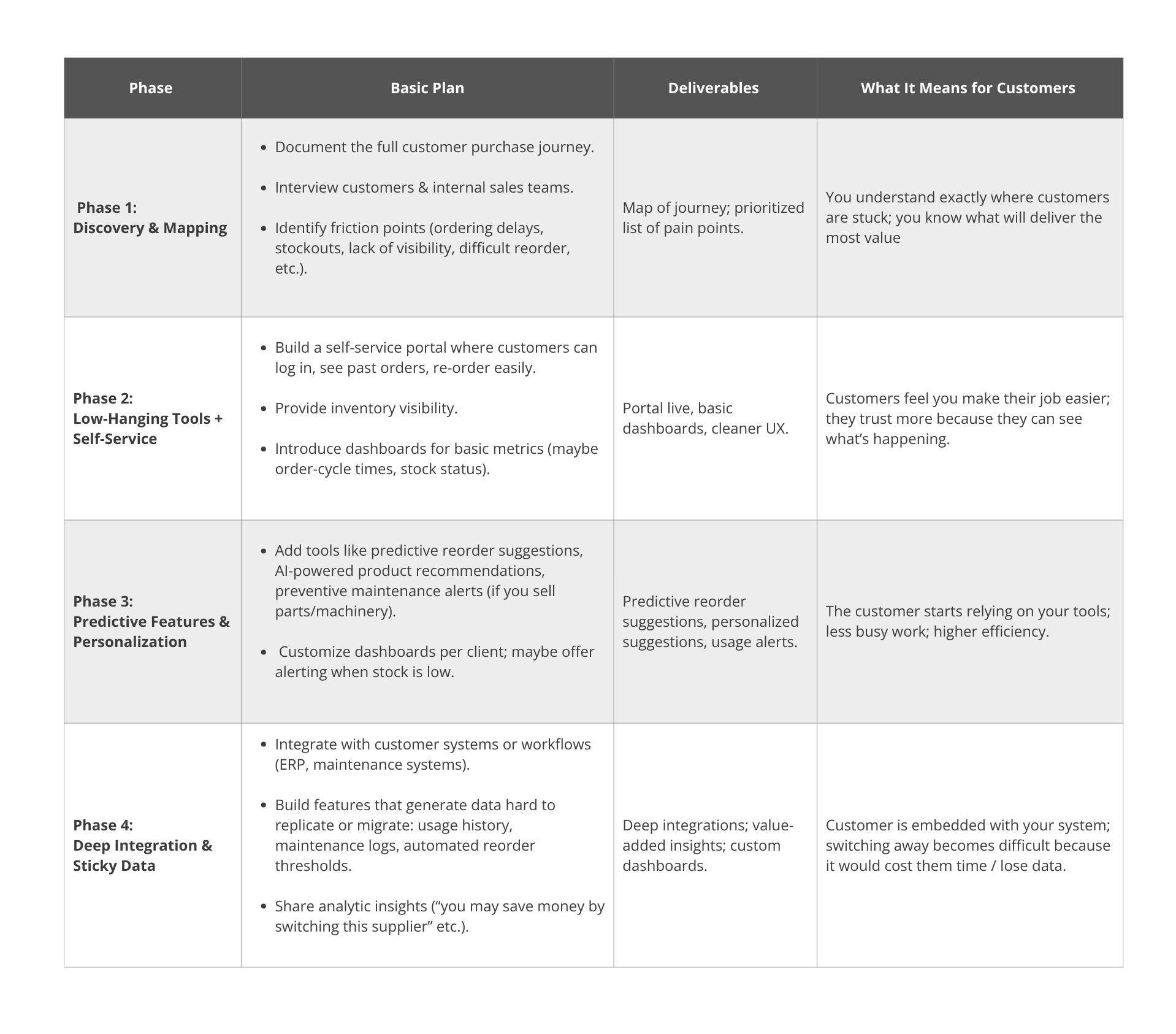
Here is a phased roadmap you can follow to build a strong digital moat. You can adapt it to your scale, industry (MRO, PPE, industrial machinery, etc.), and maturity.
Who This Approach Works Best For
While this approach works broadly, it is especially useful for:
- MRO (Maintenance, Repair, Operations): Customers rely on predictive maintenance, fast reorders, and visibility.
- PPE / Safety Equipment: Compliance, expiration, and regulatory data create high value.
- Industrial Machinery / Spare Parts: Downtime costs are high, so predictive replenishment and repair kits matter most.
- Commodity Distribution (fasteners, cleaning supplies): Even in low-margin spaces, guided alternatives, usage dashboards, and inventory tracking create loyalty.
Challenges & What to Watch Out For
- Data migration & integration cost: Getting customer data (usage, inventory, past orders) into dashboards or portals often requires manual work or system integrations.
- Change management: Internal buy-in matters. Sales, operations, IT must work together. Otherwise, new features may be under-used.
- Metric tracking: It’s easy to build tools, but harder to track impact (churn, CLV growth, reorder frequency etc.). Without tracking, you won’t know what’s working.
- Customer training and adoption: If you build something but customers don’t use it, it doesn’t create the moat. Need support, clear UX, perhaps incentives.
Real-World Case Study Powered by KaarTech
Case: Procurement Dashboard for a Healthcare Supplier
KaarTech created portals that allow customers to log in and review metrics related to their purchases. These insights help buyers make better decisions for future procurement.
The result was a practical tool that gave customers more visibility and control over their purchasing process, reinforcing the distributor’s role as a trusted partner.
This demonstrates how KaarTech helps distributors transform ordinary e-commerce systems into indispensable digital ecosystems that protect revenue and deepen loyalty.
Conclusion: Make Your Platform the Easiest Place to Buy
A digital moat for e-commerce isn’t built with one feature. It’s the accumulation of small, meaningful improvements that buyers use every day until your portal becomes the path of least resistance. The result: higher lifetime value, lower churn, and a brand position competitors can’t copy overnight.
At KaarTech, we’ve helped manufacturers and distributors design and deploy digital moats that turn transactional buyers into long-term partners. From predictive reorder portals to compliance dashboards and ERP-integrated tools, we know how to make your platform indispensable.
Let’s talk about building your moat. Contact us today to start your digital transformation.
FAQ’s
1. What is a digital moat in e-commerce?
A digital moat in e-commerce is the use of online tools and features like portals, dashboards, and predictive reorders that make it harder for customers to switch to a competitor.
2. Why do distributors need a digital moat?
Distributors need a digital moat to keep customers loyal, reduce churn, and compete with online marketplaces that focus on price and speed.
3. How can distributors build a digital moat?
Distributors can build a digital moat by creating self service portals, offering real time inventory visibility, adding predictive reorder tools, and integrating with customer systems.
4. What industries benefit most from a digital moat?
Industries such as MRO, PPE, industrial machinery, and commodity distribution benefit most, as these sectors face thin margins and high competition.