Building Intelligent Enterprise for Utilities with SAP
The worldwide movement toward sustainability is causing a huge shift in the utilities sector. Utility firms are under growing pressure to innovate as cities strive for more environmentally friendly futures and energy usage habits change. It is now required—not just an option—to integrate smart solutions for trash disposal, water management, energy generation, and storage.
Utilities can satisfy these demands, optimize operations, improve energy efficiency, and secure long-term success in a by utilizing SAP’s cutting-edge technology. The secret is to implement an intelligent enterprise strategy that combines analytics, automation, and data for more informed decision-making and long-term results.
In this blog, we’ll explore how utilities industry can use SAP solutions to transform into intelligent enterprises.
Utilities Industry – An Overview
The utilities sector, which offers necessities like waste management, water, and energy, is vital to the operation of contemporary society. The need for dependable and effective energy and resource management is growing along with cities and population, making this industry more and more essential to daily living and economic growth.
Nonetheless, the industry is up against formidable obstacles as a result of the worldwide movement toward sustainability and the switch to greener energy sources. In order to satisfy changing customer and regulatory demands, utility firms are being pressured to lower carbon emissions, incorporate renewable energy, and implement smarter infrastructure.
Strategic Priorities for the Utilities industry
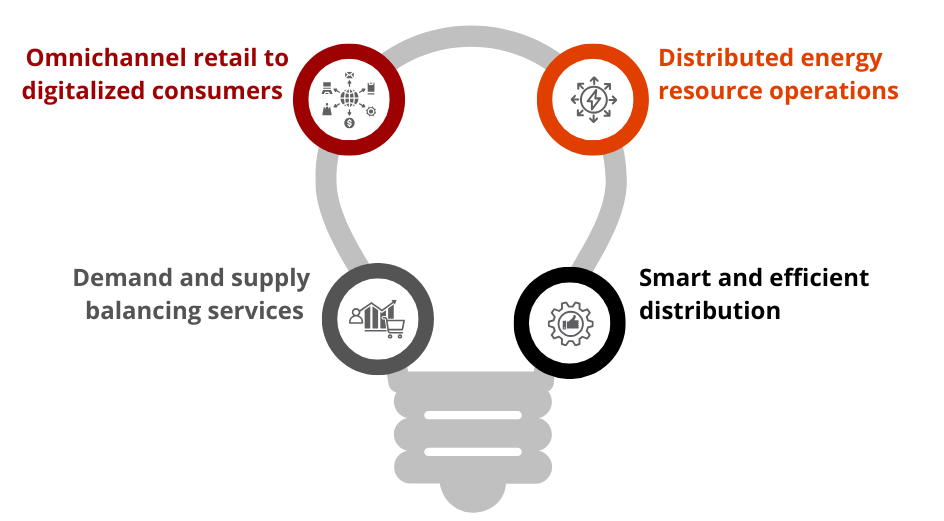
There are four essential focus areas that must be addressed for utilities to successfully evolve their business.
-
Distributed energy resource operations
Due to renewable energy sources like solar and wind, consumers are now both producers and consumers of energy. In order to ensure efficiency and transparency, utilities must adapt by utilizing smart technology to monitor and control these decentralized energy flows.
-
Smart and efficient distribution
Utilities are upgrading grids to handle decentralized energy with smart sensors and digital asset management. This will enable more efficient energy distribution, reduce costs, and ensure better maintenance and operational control.
-
Demand and supply balancing services
Managing decentralized energy production is challenging due to fluctuations in renewable sources. Utilities will need real-time data and smart systems to balance supply and demand, ensuring grid stability and optimizing energy flows.
-
Omnichannel retail to digitalized consumers
The shift to “prosumers” means consumers will produce and consume energy. Utilities must adopt digital retail models and integrate AI and IoT technologies to manage this new dynamic, providing seamless services across multiple channels.
What does Smart and Efficient Distribution actually mean?
Smart and efficient distribution focuses on modernizing traditional energy grids with advanced technologies like sensors, automation, and real-time data. This enables utilities to better manage energy flow, reduce operational costs, and improve the overall reliability of energy distribution. By optimizing grid operations, utilities can ensure more sustainable and cost-effective services.
In the traditional setup, energy distribution relies on outdated grids that lack real-time visibility and efficient asset management. Maintenance is often reactive, triggered by failures or periodic checks, leading to longer downtimes and higher operational costs. Energy distribution lacks flexibility, and the overall process is less efficient.
With smart distribution, grids are equipped with advanced sensors and digital management systems that allow real-time monitoring of energy flow. Maintenance becomes proactive through predictive analytics, optimizing asset health and reducing downtime. Utilities can ensure a smoother, more efficient energy distribution process, cutting maintenance costs and improving service reliability. This approach supports a seamless transition to a smarter, greener energy future.
Impact of Digital Transformation
Let’s contrast Company A and Company B, two utility firms. Whereas Company B has implemented a technology integrated with SAP, Company A still relies on antiquated manual procedures. The fundamental distinctions between each company’s approach to grid maintenance are listed below.
Traditional Scenario (Company A)
- Triggered by static preventive maintenance schedules or failure notes, often after issues have occurred.
- Maintenance work orders are manually scheduled and printed, leading to delays and inefficiencies.
- Technicians arrive on-site and assess the asset, but may discover that required parts or resources are missing.
- Due to missing parts or incomplete information, a second visit to the site is often required to complete the maintenance work.
- Maintenance work is recorded on paper, creating an additional delay in updating the system.
- The asset management system is updated after manual paperwork is processed, causing a lag in asset health visibility.
New-World Scenario (Company B)
- Triggered by real-time monitoring and predictive analytics based on asset health and sensor data, allowing proactive maintenance.
- Work orders are automatically scheduled, and relevant data is sent digitally to technicians for faster execution.
- Precise knowledge of the asset’s status allows automatic allocation of the right resources and spare parts before the technician arrives.
- Technicians complete maintenance in a single visit, as they have all the necessary tools and information from the start.
- Maintenance is confirmed and updated in real-time using mobile devices, ensuring immediate system updates.
- The asset management system is updated instantly, providing up-to-date information on asset health and minimizing downtime.
Building an “Intelligent Enterprise” with SAP Framework

Source: SAP
SAP’s Framework for the Intelligent Enterprise
With the power of intelligent technologies, SAP’s Intelligent Enterprise architecture can help businesses grow with a comprehensive array of apps. This framework puts businesses on the path to becoming intelligent enterprises by enabling next-generation processes that provide breakthrough business value. The essential elements of SAP’s Intelligent Enterprise framework are listed below:
- Intelligent Suite: A set of business applications that help manage core operations like customer experience, manufacturing, supply chain, employee engagement, and network management. It improves efficiency and decision-making across different areas of the business.
- Intelligent Technologies: Powered by AI, machine learning, IoT, and analytics, these technologies provide real-time insights, automation, and predictive capabilities to help businesses make smarter decisions.
- Digital Platform: Built on the cloud, this platform supports seamless data management and allows businesses to customize and expand their operations by integrating new technologies as needed.
- Customer Experience: SAP solutions help businesses create personalized and engaging experiences by using data-driven insights to enhance customer interactions.
- Manufacturing & Supply Chain: With a focus on efficiency, SAP helps streamline manufacturing processes and optimize the supply chain, allowing businesses to react quickly to changes in demand and market conditions.
- People Engagement: SAP offers tools to manage employees from hiring to retirement, increasing workforce engagement and improving productivity through smart HR solutions.
- Network & Spend Management: By giving businesses full visibility into procurement and spending, SAP enables better decision-making, cost reduction, and stronger vendor relationships.
By combining these elements, SAP’s Intelligent Enterprise framework empowers organizations to transform into highly agile.
Why Business Needs an Intelligent ERP System?
-
Adapting to Change with Agility
Businesses can swiftly adjust to new possibilities, regulations, or changes like mergers and acquisitions due to the stable yet adaptable digital core that an intelligent ERP system offers. Businesses are able to innovate, adopt new business models, and effectively address obstacles when they have a single source of truth.
-
Data and Decision Making in Real Time
Predictive analytics and machine learning are integrated by intelligent ERP systems, allowing for automated, data-driven decision-making. Workers are able to access critical information instantly, which facilitates quicker reactions. This solution ensures smooth collaboration at all levels by connecting the extended workforce and the core staff.
-
Effectively Handling Large Data
For energy firms, efficiently managing massive data sets is essential. All stakeholders, including suppliers, consumers, and workers, have real-time data access thanks to intelligent ERP systems. This makes it possible to access fast data and insights from wherever in the company, which enhances decision-making, customer service, and asset management.
-
Promoting Efficiency and Innovation
The secret to growth for utilities is to adopt innovation. Processes are simplifies, customer-focused innovations are supported, and the workforce and supply network are connected by intelligent ERP systems. This benefits utilities by increasing profitability, cutting expenses, and providing value to both prosumers and consumers.
Tackling Key Challenges in the Utilities Industry
Utilities can enhance consumer interaction by utilizing SAP to integrate data, billing information, and consumption patterns. This increases client pleasure and lowers errors by resulting in self-service alternatives, correct billing, and individualized services.
SAP’s analytics examine past data, meteorological patterns, and consumer behavior to assist utilities estimate demand. By reducing peak demand, cutting expenses, and optimizing energy generation, this enhances system stability.
Utilities may ensure smoother operations by extending asset lifecycles, minimizing maintenance costs, and reducing downtime by utilizing SAP to schedule predictive maintenance and monitor asset performance.
Top SAP Intelligent Tools to improve excellence in Utilities Industry
- SAP S/4HANA Cloud for Projects – For working with authorities and stakeholders during planning and construction phases.
- SAP Enterprise Portfolio and Project Management – For efficient management of project planning, execution, and monitoring.
- SAP Asset Management – For managing asset lifecycles and ensuring compliance with standards.
- SAP Asset Performance Management – For assessing asset risk with predictive maintenance.
- SAP Environment, Health, and Safety (EHS) Management – For standardizing health and safety protocols to ensure regulatory compliance.
- SAP Cloud for Energy – For managing secure, open energy data while meeting regulatory requirements.
- SAP Market Communication for Utilities – For secure and reliable data exchange between utilities and stakeholders.
- SAP S/4HANA Utilities Solution – For supporting meter-to-cash processes and ensuring accurate billing and compliance.
- SAP Predictive Maintenance and Service – For proactive maintenance and monitoring to reduce asset downtime.
- SAP Analytics Cloud – For real-time data processing and advanced analytics to improve decision-making.
Path ahead to the Intelligent Enterprise
- Create a Vision for Your Plan: Establish definite objectives and match your company with creative business plans and astute procedures. This guarantees that every activity is initiated with clarity and purpose.
- Build and Standardize: To standardize operations, apply best practices and a model-company strategy. Sync up with industry norms to seamlessly expedite your transition.
- Maintain Consistency in Your Running: Make sure all end-to-end experiences are consistent by utilizing on-premise, cloud, or hybrid solutions. Using the appropriate deployment models can help you maintain operational efficiency.
- Align for Ongoing Development: Continue to develop and improve by gathering insights from data. Prioritize maintaining growth and making adjustments.
What’s Next?
Creating an intelligent enterprise for utilities is more than just a phrase; it’s necessary to succeed in today’s world. Utility companies may adopt sustainable practices, improve customer experiences, and streamline operations with SAP’s innovative solutions.
Are you prepared to transform your company? Join hands with Kaartech, and we’ll help you navigate the process of digital transformation. Contact us Today!
FAQ’s
1. What is an intelligent enterprise?
An intelligent enterprise uses advanced technologies to enhance decision-making, streamline operations, and improve customer experiences.
2. How can SAP help utilities become intelligent enterprises?
SAP provides integrated solutions that enable utilities to optimize operations, leverage data analytics, and improve service delivery.
3. What are the benefits of building an intelligent enterprise for utilities?
Benefits include increased efficiency, better resource management, enhanced customer satisfaction, and improved sustainability.
4. What technologies are involved in creating an intelligent enterprise?
Key technologies include artificial intelligence (AI), Internet of Things (IoT), data analytics, and cloud computing.