
Why Every Retail CMO Needs Marketing Mix Modeling Analytics
“Half the money I spend on advertising is wasted; the trouble is I don’t know which half.”
– John Wanamaker
More than a century later, this statement still reflects the reality for many marketing leaders. With budgets spread across digital, TV, print, promotions, and social media, identifying what truly drives sales feels like guesswork. The challenge is intensified by rising customer acquisition costs and the decline of user-level tracking.
That’s why marketing mix modeling analytics has become the go-to framework for retail marketers in 2025. It brings data clarity, helps optimize budgets, and delivers measurable ROI improvements without depending on cookies or personal tracking.
Why Marketing Complexity Demands Smarter Analytics?
Retailers today juggle multiple channels like Google Ads, Instagram, YouTube, in-store promos, TV, and out-of-home. Customers interact across touchpoints, making it difficult to connect the dots. Leaders, however, expect quick answers to questions like:
- Which channels are really driving sales?
- Where should we invest more?
- What can we cut without hurting performance?
According to a Kantar study, 34% of large advertisers now use MMM over traditional attribution to guide media spend, and 80% say it helps make not just long-term but also tactical, day-to-day decisions.
Why Traditional Attribution Models Fall Short?
Conventional measurement methods such as last-click attribution, A/B testing, or year-over-year comparisons struggle to provide actionable insights:
- Last-click attribution: Ignores brand campaigns, offline media, and long-term effects.
- A/B testing: Costly and limited to narrow experiments.
- YOY comparisons: Fail to account for seasonality, economic shifts, or competitor activity.
A recent survey found 74.5% of marketers are moving away from last-click attribution, favoring holistic methods like MMM. With cookies vanishing and privacy regulations growing stricter, it’s clear these legacy models can’t keep up.
What is Marketing Mix Modeling Analytics?
Marketing mix modeling analytics is a method that examines historical aggregated data to measure how every channel and external factor (promos, seasonality, competition) contributes to outcomes like revenue or sales. It answers questions like:
- What baseline sales would have been without marketing?
- What share of sales came from marketing (incrementality)?
- Where are diminishing returns (saturation)?
- What’s true ROI or ROAS by channel?
Unlike tracking individual users, MMM uses grouped data (e.g. weekly spend & sales) and advanced statistical or machine learning techniques to estimate how marketing inputs translate into outputs. It includes offline media, long-term vs short-term effects, and helps simulate what-if scenarios for budget allocation.
How MMM Works with Advanced Analytics?
Modern MMM goes far beyond basic regression:
- Machine Learning: Detects non-linear patterns and channel interactions.
- Bayesian Models: Provide probability ranges and more robust results.
- Cloud Computing: Enables faster, more frequent model refreshes.
- Scenario Simulation: Allows marketers to test budget reallocation before making real-world changes.
For example, one retailer tested shifting budget from display to YouTube. MMM predicted higher incremental sales, and after the shift, the company saw a 20% ROAS increase in one quarter.
Measuring Incrementality, Saturation, and ROI Across Channels?
Marketing mix modeling analytics delivers three metrics that every CMO needs:
- Incrementality – The additional sales directly driven by marketing efforts.
- Saturation – Identifies the point where more spend leads to diminishing returns.
- ROI/ROAS – Compares incremental revenue to spend, providing a clear number for each channel.
Together, these metrics give marketers a playbook for maximizing every dollar.
From Insights to Action: Budget Optimization & Scenario Planning
The true power of MMM is turning analysis into actionable budget shifts.
- Should we invest an extra $2M in search or in video?
- What if we reduce print spend by 10% and double our paid social spend?
- Where do we get the highest incremental lift at current budget levels?
MMM answers these questions with confidence. By running simulations, leaders can see outcomes in advance, align with finance, and act with clarity.
Case Study: Fitness Retailer Boosts ROI by 25.6% with KaarTech
A leading U.S. retailer of wireless fitness wearables (smartwatches, pedometers, trackers) faced uncertainty about which marketing channels were working. With 5,000+ employees and US$1.04 billion in revenue, they needed a smarter way to allocate spend.
Challenges:
- Measuring sales impact across TV, radio, print, and digital was difficult.
- The budget wasn’t allocated efficiently, leading to reduced ROI.
- Teams lacked a unified view of which channels contributed most.
Solution with KaarTech:
KaarTech implemented a marketing mix modeling analytics framework tailored to the client’s marketing mix and growth objectives. Using an econometric model with TV, radio, magazines, promotions, and regional sales data, KaarTech:
- Built efficiency curves for each channel.
- Modeled incremental vs. baseline sales.
- Integrated machine learning to uncover deeper insights.
- Provided a custom dashboard for marketing & finance teams to align on spend.
Results:
- 25.6% ROI increase, from $1.68 to $2.11 per dollar spent.
- Reallocated budgets more efficiently across channels.
- Improved tracking of incremental sales and future scenario planning.
This success proves how MMM, when guided by experts like KaarTech, can turn data into dollars.
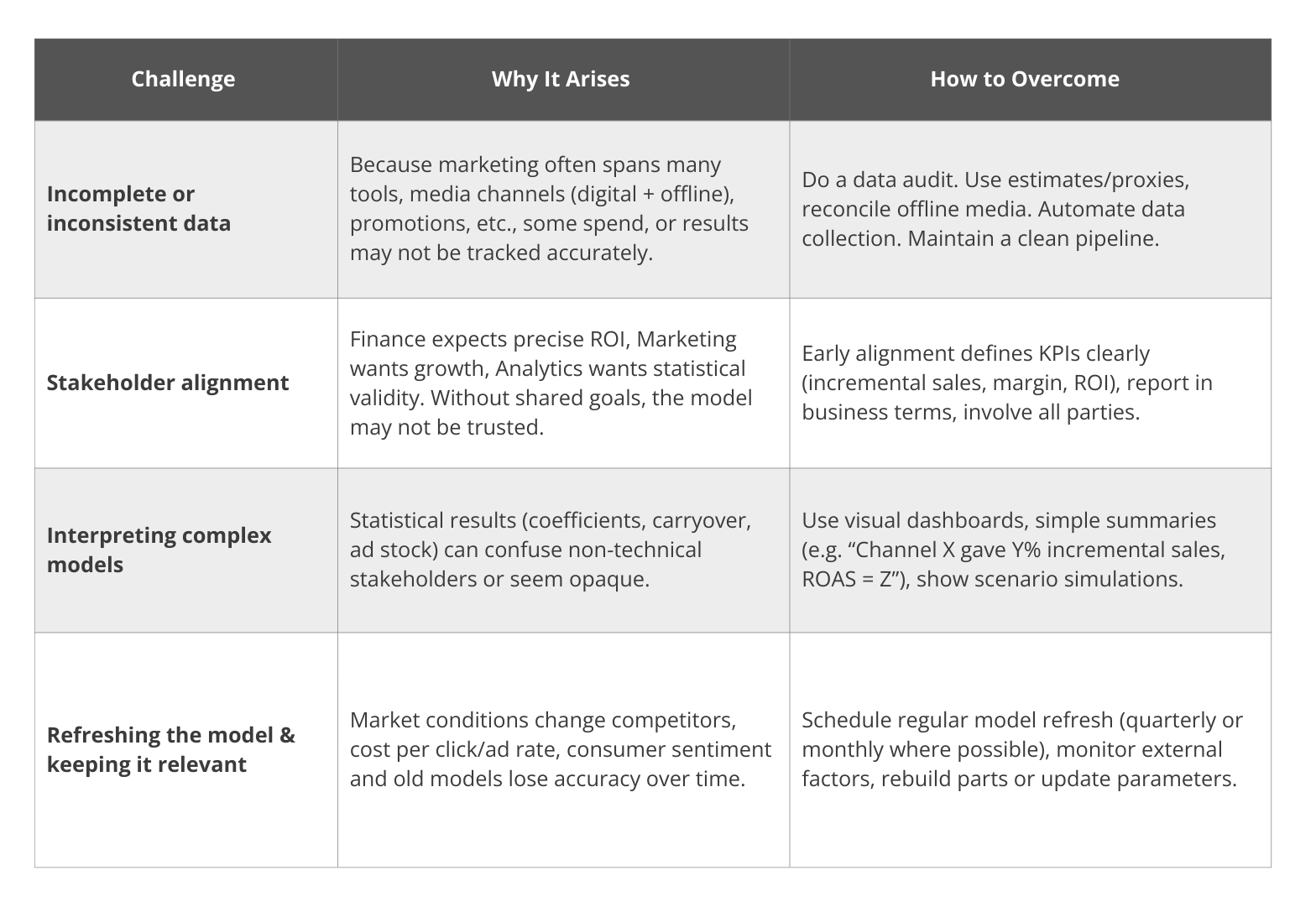
Common Challenges in MMM & How to Overcome Them
Why MMM is a Strategic Advantage in 2025?
In 2025, marketing mix modeling analytics has moved from being a reporting tool to a strategic advantage. As privacy regulations tighten and user-level tracking becomes unreliable, MMM offers a dependable way to measure marketing effectiveness using aggregated data.
- Privacy-Safe: Works without cookies or personal tracking, making it future-ready.
- Holistic Measurement: Combines digital, offline, and promotional channels into one clear picture.
- Evidence-Backed ROI: Highlights incrementality, saturation, and return on spend to guide investment.
- Scenario Planning: Allows leaders to test budget shifts before acting.
- Adaptability: Keeps businesses agile in fast-changing markets.
How to explore MMM for Your Business?
If your team is asking: Are we spending wisely? Can we prove marketing works?
Then, it’s time for MMM.
At KaarTech, we help you:
- Audit your data and check readiness.
- Build and run marketing mix modeling analytics tailored to your goals.
- Deliver insights via easy dashboards and budget optimizers.
- Speed up implementation, reduce wasted spend, and maximize ROI.
Contact KaarTech today to see how MMM can take your marketing to the next level in 2025. Let’s turn your marketing spend into measurable growth.
FAQ’s
1. What is Marketing Mix Modeling Analytics?
Marketing Mix Modeling Analytics is a data-driven approach that evaluates how different marketing channels and external factors impact sales and ROI. It helps businesses understand which investments truly drive growth.
2. How is MMM different from traditional attribution methods?
Unlike last-click attribution or A/B testing, it provides a holistic view. It measures both online and offline media, accounts for long-term and short-term effects, and avoids reliance on cookies or individual tracking.
3. Why should retail CMOs adopt MMM in 2025?
As cookies disappear and privacy regulations tighten, it offers a future-proof way to measure incrementality, saturation, and ROI. It enables smarter budget allocation and ensures marketing spend is tied directly to measurable business outcomes.
4. How can businesses get started with MMM?
The first step is to audit existing data and assess readiness. From there, businesses can build models tailored to their goals, use dashboards for insights, and run scenario simulations to optimize budgets and maximize ROI.