
Is Your E-Commerce Site Ready for AI Shopping Agents?
The e-commerce industry is undergoing a rapid transformation, fueled by the rise of AI shopping agents. These advanced digital assistants do far more than simply recommend products, they can autonomously research, compare, and purchase products, all while managing tasks like returns and customer support. With this shift towards AI shopping agents, e-commerce platforms must adapt to meet new consumer expectations.
According to recent market projections, the global AI agents in e-commerce market is set to surge from $3.6 billion in 2024 to $282.6 billion by 2034, growing at a staggering CAGR of approximately 54.7%. Just a year into this trajectory, the growth momentum is already reshaping the competitive landscape.
The message is clear: businesses that fail to incorporate AI shopping agents into their platforms risk losing out as consumer demand for personalized, fast, and seamless shopping experiences grows.
What Are AI Shopping Agents and Why Should You Care
AI shopping agents are autonomous systems designed to act on behalf of customers throughout their entire shopping journey. Unlike traditional chatbots or product recommendation engines, these agents can research, compare, and make purchase decisions independently. They understand customer preferences, provide tailored experiences, and even take care of post-purchase tasks, like returns or tracking.
As consumer demand for faster and more personalized experiences grows, businesses must leverage these intelligent retail assistants to stay competitive. These agents create an efficient and smooth shopping experience, allowing e-commerce platforms to meet evolving customer expectations. As the technology advances, integrating AI shopping agents into your platform will become essential for future success.

How AI Shopping Agents Shop Differently From Humans
Unlike human shoppers who are influenced by emotions, visuals, or trial-and-error, agentic AIs focus on structured, semantically rich, and machine-readable data. For an e-commerce platform to be compatible with AI agents, it needs more than just a user-friendly design.
Traditional websites are designed with human shoppers in mind, which works well for browsing and simple purchases. However, for AI shopping agents to thrive, your platform needs to be built with both human shoppers and AI capabilities in mind.
For that to happen, your platform will need:
- Robust APIs that allow smooth and consistent data exchange.
- Standardized product metadata that AI shopping agents can easily interpret.
- Real-time inventory access for accurate decision-making.
- Clear fulfillment protocols to ensure seamless transactions.
E-commerce sites that communicate effectively with agentic AI are positioning themselves ahead of the competition, where much of the purchasing power shifts to autonomous machines.
Why Your E-Commerce Site Needs Model Context Protocol (MCP)
If you’re thinking about integrating AI shopping agents into your platform, the first thing you’ll need is a solid system for making sure these agents can interact with your site. That’s where Model Context Protocol (MCP) comes into play.
MCP acts as a connective layer, enabling these smart retail agents to understand and interact with your platform’s backend in real time. By using MCP, they can better understand the context of each shopping interaction and respond in a way that is both adaptive and personalized.
Without MCP, digital assistants struggle to process complex data and make intelligent decisions in real-time. This ensures that these agents can access and interpret data, query different data sources, and offer highly personalized responses that are tailored to the user’s preferences and behaviour.
How MCP Improves the Shopping Experience
To be effective, AI shopping agents need to perform complex tasks like comparing prices, checking stock, and interpreting policies. MCP enables:
- Ask clarifying questions to narrow down product options.
- Compare product bundles to find the best value.
- Verify shipping policies to provide accurate delivery times.
- Handle exceptions like stock unavailability or shipping issues without human intervention.
This ability to carry out intelligent, multi-step processes makes it indispensable for creating a smooth and efficient shopping experience driven by AI shopping agents.
MCP vs. Traditional Web Services: Key Differences
Here’s a comparison table highlighting the key differences between a Model Context Protocol (MCP) server-based solution and traditional web services:
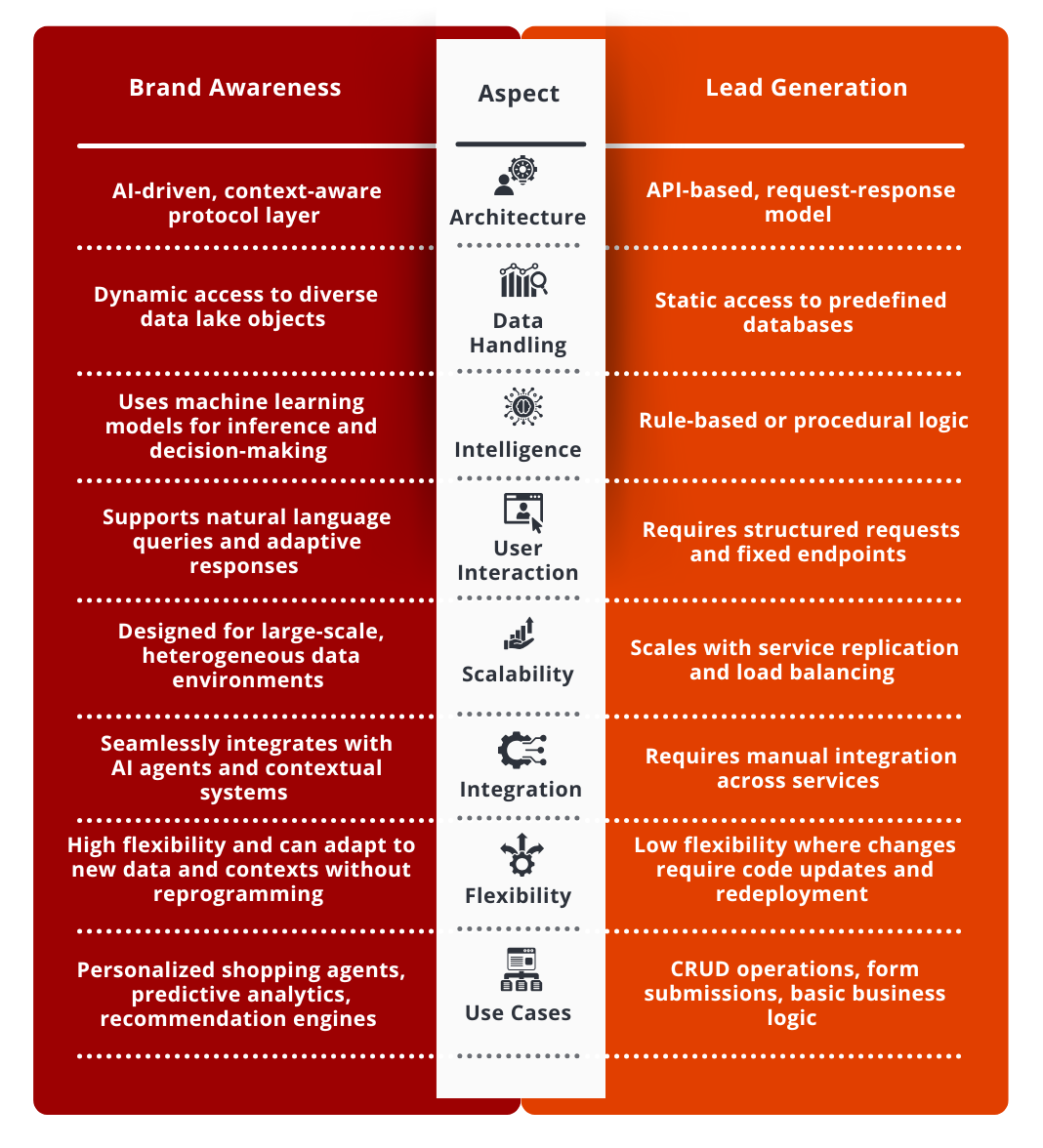
This table highlights how MCP provides a more flexible, scalable, and intelligent solution for supporting AI shopping agents, compared to traditional systems.
How to Support AI Shopping Agent’s Decision-Making Journeys
To fully support AI shopping agents, your platform must handle advanced logic and dynamic decisions. These virtual buying companions require your system to:
- Compare multiple products based on various criteria like price, features, and ratings.
- Ask clarifying questions to refine the product search.
- Verify shipping policies and calculate accurate delivery times.
- Handle issues like stock shortages or price fluctuations without any human interference.
With MCP in place, your platform becomes a smart environment, empowering digital agents to deliver accurate, personalized, and fast shopping journeys.
The Impact of AI Shopping Agents on Consumer Behaviour
As more consumers rely on AI shopping agents, expectations are rising. Shoppers now demand hyper-personalized, efficient experiences. The ability to act on behalf of users is revolutionizing how purchases happen.
Consumer Preferences:
- 70% of online shoppers prefer interacting with AI shopping agents for product recommendations and price comparisons.
- 68% of customers are more likely to purchase from a website that uses AI-powered recommendations.
- E-commerce platforms that use AI powered chat tools have seen conversion rates increase from around 3.1 % to 12.3 %, which is nearly four times higher than platforms without intelligent automation
Clearly, businesses embracing these digital assistants are reaping the rewards.
The E-Commerce Roadmap to Support Agentic AI Shopping
Adapting to this new world of AI-powered shopping requires an updated approach to e-commerce. To start, businesses need to audit their current digital infrastructure and ensure their site can support agentic AI.
Key Questions for AI-Readiness:
- Can your site be easily parsed by AI agents?
- Do your product pages have complete, machine-readable specs?
- Is your backend flexible enough to integrate with agent orchestration systems?
If you’re unsure where to start, KaarTech can help you build a roadmap for AI-readiness updating schemas, documenting APIs, implementing AI-native interfaces, and testing agent interactions. These steps will ensure that your platform doesn’t just survive the agentic revolution it thrives in it.
How KaarTech Helps You Get There
Adopting AI shopping agents requires careful preparation. At KaarTech, we offer AI Shopping Strategic Advisory services to help you get your platform ready for the future of e-commerce. We assist with:
- Auditing your current platform to ensure it can support AI shopping agents.
- Integrating MCP for smarter, more adaptive interactions.
- Creating flexible and secure APIs for seamless integration.
- Testing AI interactions to ensure the best user experience.
Contact KaarTech to Prepare for the Future of Shopping
The rise of AI shopping agents is inevitable, and now is the time to ensure your platform is ready. Contact KaarTech today to learn how we can help you integrate AI shopping agents and MCP into your strategy and keep your e-commerce site ahead of the competition.
FAQ’s
1. What are AI shopping agents?
AI shopping agents are autonomous digital assistants that research, compare, and purchase products on behalf of users, offering a faster and more personalized shopping experience.
2. Why do e-commerce platforms need Model Context Protocol (MCP)?
MCP helps AI shopping agents interact with backend systems, enabling real-time, context-aware decisions for smoother, smarter customer journeys.
3. How are AI shopping agents different from chatbots?
Unlike rule-based chatbots, these agents can independently make purchase decisions, handle returns, and personalize recommendations using contextual intelligence.
4. How can I make my e-commerce site ready for AI shopping agents?
Start by updating your APIs, standardizing metadata, ensuring real-time inventory, and integrating MCP to support intelligent agent-driven transactions.