
SAP S/4HANA Cloud – What You Need to Know?
Enterprise Resource Planning (ERP) technologies have changed dramatically during the last few decades. In the past, companies would buy software licenses and oversee installations in their own data centers or via outside hosting companies. But when cloud computing gained popularity, the market changed significantly, and Software as a Service (SaaS) solutions took over because of their unmatched flexibility and capacity to handle challenging business problems.
SAP redesigned its ERP products to accommodate this change. The company has completely redesigned its product stack with cloud-native components with the release of SAP S/4HANA Cloud, providing enterprises with an innovative solution. A complete, next-generation business suite that is tailored to the requirements of contemporary enterprises is offered by the SAP S/4HANA Cloud.
Types of SAP S/4HANA Cloud
- Public Cloud Edition
- Private Cloud Edition
- Hybrid Cloud Implementation
1. Public Cloud Edition:
The Public Cloud offers a cost-effective, scalable, and efficient SaaS solution, where customers share the same infrastructure. Businesses can upload their data and select the features they require, making it an ideal choice for companies with standardized or adaptable processes. The time to live operation is typically measured in weeks, and SAP manages support, including upgrades and patches.
Key Characteristics:
- Limited functionalities compared to the Private Cloud edition.
- Fewer customization options, offering a restricted set of features.
- Maintenance, updates, and patches are scheduled by SAP, with no client control over the timing.
Ideal For: Organizations with simple, standardized processes that can adapt quickly to cloud functionalities.
2. Private Cloud Edition:
The Private Cloud edition is a more flexible and scalable solution, providing each customer with a dedicated virtual environment. Unlike the Public Cloud, it has no constraints on language, country, or location, making it suitable for organizations with more complex needs. SAP manages the entire infrastructure, but clients have more control over upgrade schedules to avoid disruptions to operations.
Key Characteristics:
- More flexibility than the Public Cloud.
- Customization options available to meet specific business needs.
- Clients have control over the timing of updates and patches.
Ideal For: Enterprises with complex requirements or those needing greater control over their cloud environments and update schedules.
3. Hybrid Cloud Implementation:
Recognizing that large-scale organizations often require a combination of cloud environments, Hybrid Cloud implementations allow businesses to mix Public Cloud, Private Cloud, and on-premise SAP S/4HANA solutions. This hybrid approach offers flexibility in migrating different parts of the business to the cloud at different speeds, according to digital transformation goals.
Key Characteristics:
- Seamless integration between Public Cloud, Private Cloud, and on-premise environments.
- A unified experience for users, making it difficult to distinguish between the various cloud and on-premise systems.
- Predefined scenarios for central finance and central procurement to streamline hybrid operations.
Ideal For: Organizations with a phased digital transformation plan, requiring a combination of cloud environments to meet specific business objectives.
Key Features of S/4HANA Cloud
By utilizing in-memory computing, SAP S/4HANA Cloud provides real-time data analytics that facilitate prompt decision-making and more precise forecasting.
The platform’s API customisation feature enables smooth interaction with external apps and guarantees flexibility to meet specific business requirements.
By supporting cloud, on-premise, or hybrid models, it provides deployment flexibility, enabling companies to select the one that best suits their infrastructure and regulatory needs.
Architecture of S/4HANA Cloud
- The SAP HANA in-memory database serves as the foundation of SAP S/4HANA Cloud, allowing for the rapid processing of massive amounts of data for real-time operations.
- With its modular architecture, SAP S/4HANA Cloud provides scalable solutions that can be added or modified to meet the demands of particular industries.
- The platform offers scalability, flexibility, and ease of maintenance, and it is built to fully utilize cloud settings.
- A strong security mechanism built into SAP S/4HANA Cloud guarantees data protection and adherence to legal requirements like GDPR.
Three Main Components of SAP S4HANA Cloud
1. SAP CoPilot, or personal digital assistant:
- A virtual assistant that communicates with ERP applications and features.
- Gives task-relevant information according to the job requirements and the context of the user.
2. Machine Learning:
- Minimizes the possibility of errors by automating repeated processes.
- Uses learnt automation to improve efficiency and consistency.
3. Predictive Analytics:
- Integrated analytics for forecasting activities, such as sales forecasting and inventory control.
- Programs that can be tailored for certain use situations, including forecasting delivery schedules or the possibility of a sales conversion.
Main Differences Between On-Premise and SAP S/4HANA Cloud
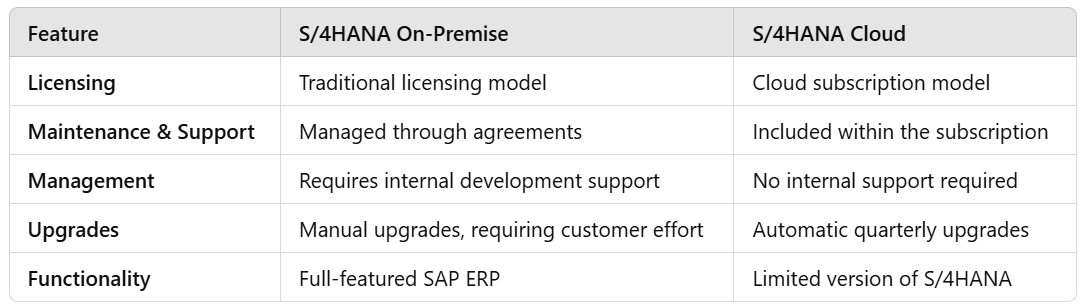
Challenges with SAP S/4HANA Cloud
The primary drawback of S/4HANA Cloud is its limited functionality compared to full on-premises S/4HANA and its inability to be altered. Because of this, it is less suitable for big businesses that require specialized capabilities due to their complex and changing business process needs.
By using hybrid configurations that take use of specific S/4HANA Cloud features, like S/4HANA Finance, while keeping more complex S/4HANA services on-premises, many firms can still profit from S/4HANA Cloud.
While S/4HANA on premises is utilized in headquarters, larger organizations may also employ S/4HANA Cloud in smaller organizational units, such as different geographic areas or corporate divisions.
Advantages of SAP S/4HANA Cloud
- Reduced Maintenance: Updates and infrastructure can be managed without internal resources.
- Automatic Updates: Regular updates that don’t require human involvement.
- Scalability: As business requirements change, cloud architecture makes it simpler to scale.
- Cost-effective: Compared to on-premise, a subscription approach may be more predictable and have lower upfront expenses.
The Future of SAP S/4HANA Cloud
- Increased Adoption: Due to SAP S/4HANA Cloud’s scalability and user-friendliness, more companies—particularly small and mid-sized ones—are anticipated to switch as cloud technology advances.
- Hybrid Solutions: To optimize the advantages of both cloud and on-premise SAP solutions, many businesses will probably keep utilizing hybrid configurations.
- Continuous Innovation: In order to deliver even more intelligent solutions, SAP is anticipated to improve cloud offerings by further integrating AI, ML, and predictive analytics.
Conclusion
When compared to on-premise systems, SAP S/4HANA Cloud provides a simplified, adaptable ERP solution with notable cost savings. It is an appealing option for companies seeking efficiency and scalability due to its capacity to instantly adapt and deliver a true digital core.
SAP S/4HANA Cloud is positioned to be a major participant in the upcoming months and years as market interest increases.
Contact with our experts today to learn more about how SAP S/4HANA can advance your company!
FAQ’s
1. What is SAP S/4HANA Cloud?
A cloud-based ERP suite with real-time data processing, predictive analytics, and flexible deployment options.
2. How is SAP S/4HANA Cloud different from on-premise?
Cloud offers scalability, automatic updates, and lower maintenance, while on-premise allows for more customization and control.
3. Which SAP S/4HANA Cloud edition should I choose?
Public Cloud is for standardized processes, Private Cloud for flexibility, and Hybrid Cloud for a mix of both.
4. How does SAP S/4HANA Cloud support digital transformation?
It streamlines operations, provides real-time insights, and integrates advanced technologies like machine learning.