
SAP ECC to S/4HANA Migration – A Beginner’s Guide
In 2018, SAP announced a significant change in its enterprise resource planning (ERP) strategy prompting companies to migrate from SAP ECC to SAP S/4HANA by 2025. This timeline has since been extended due to slow adoption and limited number of SAP consultants.
However, the urgency continues as over 35,000 organizations are already using or implementing SAP S/4HANA. With SAP ECC soon to be out of support, this migration is a great concern among CIOs, IT leaders, and CFOs.
The SAP ECC to S/4HANA migration is not just a technical upgrade but a way of doing business that can strongly influence business operations and value realization. Companies have found that the transition to S/4HANA is challenging.
Why wouldn’t it be difficult? As S/4HANA represents a significant upgrade to existing ERP solutions, and overhauling the legacy ERP system is no small task.
Despite the difficulties, there are compelling reasons why businesses should migrate to SAP S/4HANA. Notably, 37% of companies have reported a revenue boost after implementing S/4HANA. Forrester estimates a revenue increase of nearly $156 million within three years of using S/4HANA.
In this guide, you’ll discover the key differences between SAP ECC and S/4HANA, and understand why businesses are making the switch. We’ll highlight the exciting new features and significant business benefits of S/4HANA. Additionally, we’ll explore different migration approaches and provide a concise, step-by-step process to ensure a smooth S/4HANA migration journey.
What is SAP ECC?
SAP ECC (Enterprise Resource Planning Central Component) is the predecessor to SAP’s enterprise resource planning software. This system consists of modules that can be customized to fit the needs of an organization by integrating different operations of Finance, Logistics, HR, Product Planning and Customer Service to improve business activities.
However, these modules are complex to manage because changes in one module may affect others. By 2027, support for SAP ECC will end, and organizations are advised to move to SAP S/4HANA to enjoy ongoing support and updates.
What is SAP S/4HANA?
SAP S/4HANA which is a short form of “SAP Business Suite 4 SAP HANA” short for SAP Business Suite 4 SAP HANA, is the next-generation ERP application designed by SAP. It uses the HANA in-memory database engine for enhanced business analytics and faster data processing capabilities.
It integrates with other business systems to have personalized insights about their customers, improve customer experience and achieve comprehensive automation. It has also incorporated new technologies like AI, IoT as well as advanced process automation making it an indispensable tool for global companies to survive or outpace their competitors.
SAP S/4HANA Migration Approaches
Depending on your current SAP deployment, there are three strategies to transition to SAP S/4HANA: Greenfield, Brownfield, and Hybrid. Each approach has its benefits and challenges that you need to consider when selecting one based on your existing workflows, configurations as well as database structure.
1. Greenfield Approach (New Implementation)
A Greenfield installation involves rebuilding your entire enterprise resource planning (ERP) infrastructure from scratch on the S/4HANA platform. This includes process flows, workflow automations, integrations, and configurations, without importing existing system structures.
While this approach is the most expensive and requires an aggressive training regimen for users to familiarize themselves with the new UI, workflow logic, and S/4HANA tooling, it allows enterprises with outdated SAP applications and infrastructure to fully reimagine and redefine their ERP processes.
Best for: Enterprises with legacy SAP applications and infrastructure over 20 years old looking to completely redesign their ERP processes.
2. Brownfield Approach (Full Migration)
The Brownfield approach, or system conversion, is recommended for customers who want to switch to S/4HANA while preserving their custom applications, workflows, and data structures. This method helps avoid costly disruptions to enterprise resource planning operations by migrating and adapting existing processes to the S/4HANA platform.
SAP provides tools and extensive documentation to facilitate this transition. However, there is a risk of encountering technical issues that could delay operations more than expected.
Best for: Enterprises committed to the SAP application suite and SAP implementation partners providing third-party support.
3. Hybrid Approach
The Hybrid approach combines elements of both Greenfield and Brownfield strategies and can take two pathways:
- Empty Shell Migration: Generate a copy of your existing system, excluding live data, discard any configuration settings and programs you no longer intend to use, repair those you plan to use on S/4HANA, then upgrade and move your data back in.
- Mix & Match Migration: Run an S/4HANA instance, import existing configurations and data, and operate your ECC instance concurrently until the migration is complete. This approach offers flexibility and agility, allowing enterprises to integrate best-of-breed applications and change processes as needed.
Best for: Enterprises looking to build parts of their new S/4HANA ERP from the ground up while maintaining the flexibility to integrate various applications and processes.
To determine the most suitable migration approach for SAP S/4HANA, it’s essential to conduct an assessment workshop. This workshop should involve key stakeholders such as IT, business process owners, and experienced advisory consultants.
Choosing the Right SAP S/4HANA Migration Approach: Greenfield, Brownfield, or Hybrid?
Although each organization may have different priorities, the following guidelines can help in making the right choice:
- Assess Technical Readiness: Ensure your existing ECC system meets the technical criteria for conversion to S/4HANA. SAP provides clear guidelines and prerequisites for this conversion. Verify that your SAP system, business functions, add-ons, and industry solutions are supported in the roadmap for migrating to S/4HANA.
- Evaluate Customization and Signature Processes: Review your process master list and customization list. Determine if these processes are still relevant, unique, and necessary. If it is essential to retain custom processes, the Brownfield approach might be more appropriate.
- Consider Data Retention Requirements: The Greenfield approach resembles a fresh implementation, where only clean master data and open transactions are carried forward. If you need to retain historical data in your live SAP system, the Brownfield approach may be a better option.
- Plan Your Roll-Out Strategy: If a Big Bang approach and a global solution are needed, the Brownfield approach might be more suitable. Conversely, a Greenfield approach allows for a phased rollout of the solution to different regions or business units.
- Align with Long-Term Strategic Goals: If your current SAP system cannot promote innovation and growth, and you view S/4HANA as a platform to modernize processes and integrate intelligent technologies like AI, ML, and IoT, you may need to choose greenfield implementation.
By carefully evaluating these factors, it will be possible for you to opt for the right approach to be used when migrating to SAP S/4HANA that aligns with your organization’s needs and goals.
7 Things to Consider Before an SAP S/4HANA Migration
An SAP S/4HANA migration offers many benefits, but to ensure a smooth transition, it’s crucial to understand your specific reasons for migrating. This isn’t just an update or upgrade; it’s about introducing a new digital core to ensure your enterprise’s future competitiveness. Both technical and business process designs need to be adapted for optimal success.
Key Questions to Address
- What is Your Target Status?
Determine the role SAP S/4HANA will play in your system landscape. Are you planning a proof of concept (PoC), or will you use SAP S/4HANA immediately in production? Can the migration help optimize your business processes?
- Which Operating Model is Best?
Decide whether to run SAP S/4HANA in your data center, through a hosting service, or as a software as a service (SaaS) model.
- What is Your Initial Situation?
Assess the current version of your source system, the quality of your data, adherence to SAP standards, and the extent of custom enhancements.
- How Many Users Will Be Involved?
Identify the number of users and their distribution. Determine which user groups will benefit most from SAP S/4HANA implementation.
- How Will the Solution Be Used?
Specify which business scenarios and transactions will be used and how these requirements are distributed among your users.
- What is Your Defined Time Frame?
Establish the project’s timeline, including key milestones and their deadlines.
- Do You Need Support?
Determine the type of support needed, your budget, and which services will be outsourced versus those provided in-house.
Step-by-Step Process for SAP S/4HANA Migration
If you’re striving to get more out of your existing SAP ECC system, then it’s time to revise your current processes and follow the best practices for SAP S/4HANA implementation.
Step 1: Familiarize with SAP S/4HANA
To ensure a smooth transition, users need to get acquainted with S/4HANA’s features, functionalities, modules, and workflows. This helps in maximizing the system’s benefits and selecting the right deployment option:
- SAP S/4HANA Cloud, Public Edition: Hosted in a public cloud, offering scalability and flexibility, managed by SAP.
- SAP S/4HANA Cloud, Private Edition: Hosted in a private cloud, providing more control, security, and customization, managed by SAP.
- SAP S/4HANA On-Premises managed by SAP (HEC): On-premise deployment with SAP managing the infrastructure, combining control with reduced operational burden.
- SAP S/4HANA On-Premises: Traditional on-premise deployment offering maximum control and customization, requiring in-house management.
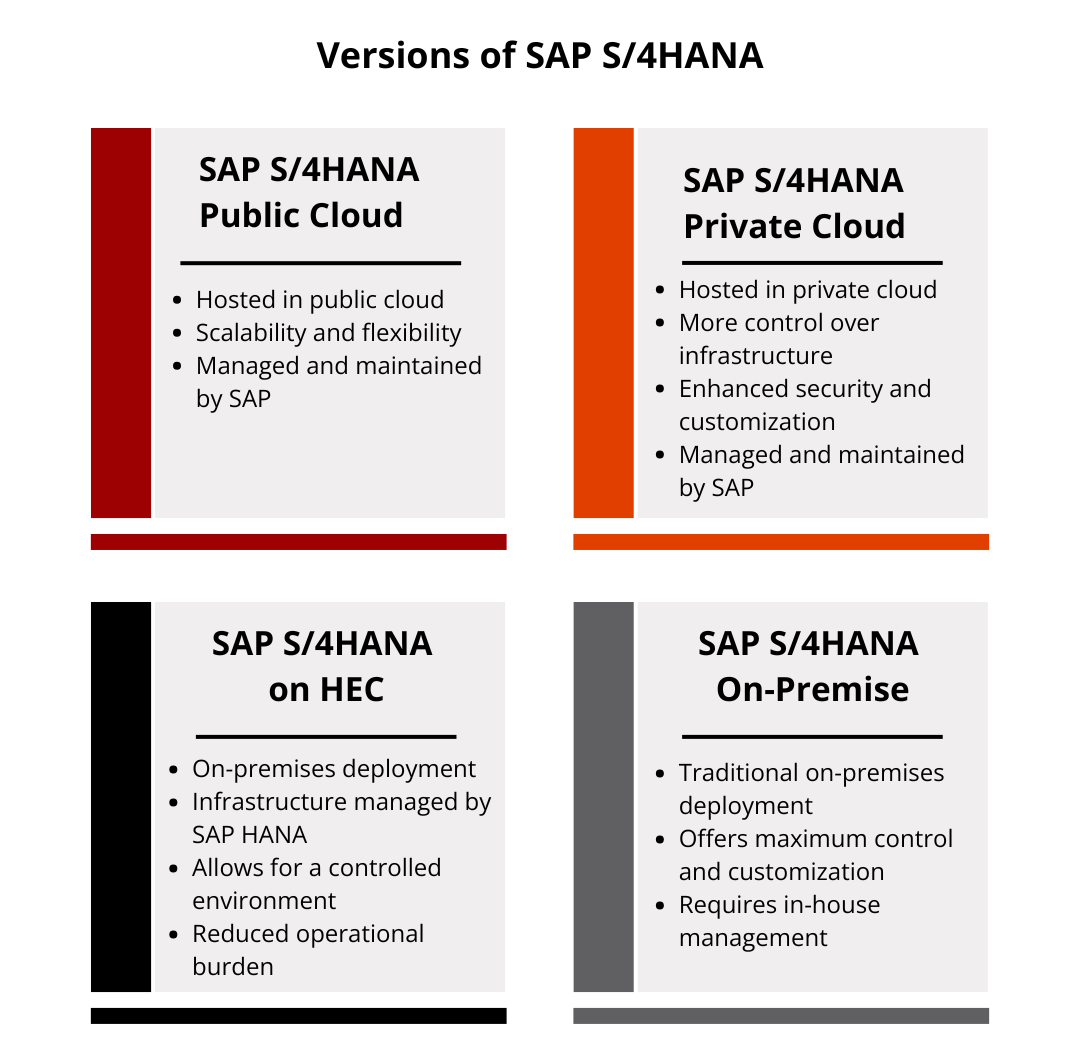
Choosing the right option depends on business needs, infrastructure preferences, and the level of control desired.
Step 2: Data Analysis and Classification
Classify data into hot, warm, and cold categories to optimize the migration process:
- Hot Data: Frequently accessed, critical data to be transferred to the S/4HANA database for high-performance access.
- Warm Data: Less frequently accessed but relevant data to be stored in the S/4HANA system database for a balance between performance and storage efficiency.
- Cold Data: Infrequently accessed or historical data to be archived, reducing the load on the live system and optimizing resources.
Step 3: Data Cleansing
Cleanse the data to ensure accuracy and reliability during migration:
- Duplicate Removal: Eliminate duplicate records.
- Standardization: Normalize data formats and values.
- Validation: Verify data accuracy against predefined rules.
- Enrichment: Augment data with additional information.
- Error Correction: Rectify inaccuracies to meet quality standards.
Utilize SAP tools like SAP Data Services and SAP Information Steward for efficient data cleansing.
Step 4: Readiness Check
SAP Readiness Check assesses system compatibility and readiness for migration:
- System Analysis: Evaluates the existing SAP ECC system for migration readiness.
- Simplification Items Identification: Highlights simplification items specific to the S/4HANA version.
- Custom Code Analysis: Detects custom code incompatibilities and provides adjustment insights.
- Data Volume Management: Assesses data volumes to optimize storage and performance.
- Business Process Analytics: Aligns current processes with S/4HANA best practices.
Initiate the readiness check, collect data, analyze it, and use the results to plan the next steps in the migration journey.
By following these steps, organizations can ensure a smooth transition from SAP ECC to SAP S/4HANA, optimizing system performance and leveraging new capabilities for improved business operations.
Why Wait?
There are many differences between SAP ECC and SAP S/4HANA. This can make migrating from one to the other a daunting prospect. But there’s a strong business case for migrating to SAP S/4HANA—not least the 2027 maintenance deadline for SAP ECC.
SAP S/4HANA offers significant advantages, including faster data processing with the HANA in-memory database, simplified data models, advanced analytics, and a modern user interface with SAP Fiori. These features drive operational efficiency, better decision-making, and improved customer experiences.
At KaarTech, with over 20 years of experience, our team of 900+ specialized consultants has successfully executed more than 75+ SAP S/4HANA transformations.
Ready to migrate? Contact us or schedule a consultation with our experts to guide you through the SAP ECC to S/4HANA migration process.
FAQ’s
1. What is SAP ECC?
SAP ECC, or Enterprise Resource Planning Central Component, is the older ERP system from SAP, integrating functions like Finance and Logistics. Support ends in 2027, necessitating a move to SAP S/4HANA for continued updates and support.
2. Why migrate to SAP S/4HANA?
SAP S/4HANA offers faster data processing with its HANA in-memory database, simplified data models, advanced analytics, and a modern user interface with SAP Fiori, enhancing operational efficiency and decision-making.
3. What are the main migration approaches?
The three primary approaches are Greenfield (complete rebuild), Brownfield (migrating existing processes with minimal disruption), and Hybrid (a combination of both). The choice depends on technical readiness, customizations, data needs, rollout strategy, and strategic goals.
4. How can organizations prepare for an SAP S/4HANA migration?
Organizations can prepare for an SAP S/4HANA migration by conducting a readiness assessment, cleansing and classifying data, evaluating migration approaches, and ensuring alignment with long-term business goals and technical requirements. This proactive approach helps streamline the migration process and minimize potential disruptions.