

Role of Material Management (SAP MM) in your Organization
Introduction
This SAP MM blog will introduce the SAP MM Module, which is a key component of SAP ERP software. The SAP Material Management (MM) module is used by many companies to efficiently manage their purchasing and transactional data, saving both time and costs. It is part of the logistics function and supports the entire process from procurement to product delivery.
The SAP MM Module includes various components that manage material procurement, vendor relationships, material quality inspections, and vendor payments.
Additionally, the SAP Business Process within the SAP MM Module is crucial as it oversees several functions, including sales, manufacturing, distribution, maintenance, planning, and warehouse management. It also helps in managing inventory and human resources for the company.
SAP and modules overview
When it comes to ERP (Enterprise Resource and Planning) products and services, SAP is the industry leader. Several functional modules found in SAP solutions enable transactions to carry out important business activities, including
- Human Resource Management (SAP HRM)
- Production Planning (SAP PP)
- Material Management (SAP MM)
- Financial Supply Chain Management (SAP FSCM)
- Sales and Distribution (SAP SD) and many more.
Here will see an overview of the SAP MM Module. It covers its features and how it operates, explaining various components and subcomponents.
Importance of Material Management in Organizations
Organizations need material management because it lowers financial risks by cutting waste and optimizing inventory levels, which in turn increases cost efficiency.
Effective management assures timely material availability, which improves the output and quality assurance while raising customer satisfaction.
In order to keep a competitive edge and accomplish strategic goals, material management plays a critical role in promoting sustainability and flexibility in operation.
What is SAP Material Management?
To improve logistics and supply chain operations in an organization, use Materials Management (MM) module of SAP S/4HANA ERP software. This module aims to manage key processes like inventory control, purchasing, receiving goods, storing materials, and planning based on consumption patterns.
Logistics involves managing tasks such as procurement, storage, transportation, and delivery of goods throughout the supply chain. A supply chain is a network of organizations—such as retailers, distributors, transporters, storage facilities, and suppliers—that collaborate to produce and deliver a specific product.
SAP MM (Material Management) is a module that assists organizations in managing materials and inventory effectively. It oversees the entire process from purchasing to payment, including tracking inventory and verifying final invoices. The module streamlines procurement, ensuring that the right materials are available when required.
Key Features of SAP MM
1. Inventory Management:
Minimizes stock-outs and overstocking and enhances cash flow, customer service, and cost savings by effectively managing inventory levels, tracking stock movements, and optimizing inventory.
2. Integration with Other SAP Modules:
Enables enterprises to automate end-to-end business operations by integrating easily with other SAP modules including Financial Accounting (FI), Production Planning (PP), and Sales and Distribution (SD).
3. Centralized Procurement:
Offers a centralized method for procuring goods and services, allowing users to combine purchases and utilize their combined purchasing power to bargain with suppliers for better terms and pricing.
4. Automated Procurement Process:
SAP MM streamlines procurement by automating purchase requisitions, approvals, and order processing. This reduces manual effort, minimizes errors, and ensures timely material availability.
5. Supplier Evaluation & Management:
The module provides tools for evaluating vendor performance based on delivery timelines, quality, and pricing. This helps businesses select reliable suppliers, negotiate better contracts, and maintain strong supplier relationships.
Three main flows that make up the SAP Material Management
Three primary flows comprise the Material Management (SAP MM) module, which is an integral aspect of logistics, and are crucial to the supply chain. Among these flows are

Together, let’s look at each one!
1. Material Flow
Material flow refers to the movement of materials from suppliers to a business and then to customers, including any returns from customers. Companies are increasingly integrating their processes with suppliers and customers to improve communication and efficiency. By enhancing transparency in material flow, businesses can become more adaptable and responsive to customer needs. This responsiveness can give them a competitive edge, making them appear more flexible, quick, and reliable.
2. Financial Flow
Financial flow involves the documentation and accounting associated with the transportation of materials. This includes tracking the value of materials through credit or debit transactions. For example, when materials are moved from inventory to accounts payable, this reflects a financial flow.
3. Informational Flow
Informational flow is concerned with the exchange of information related to orders and delivery tracking. Companies that use real-time information to communicate with clients and suppliers can gain a competitive advantage by demonstrating their reliability and efficiency.
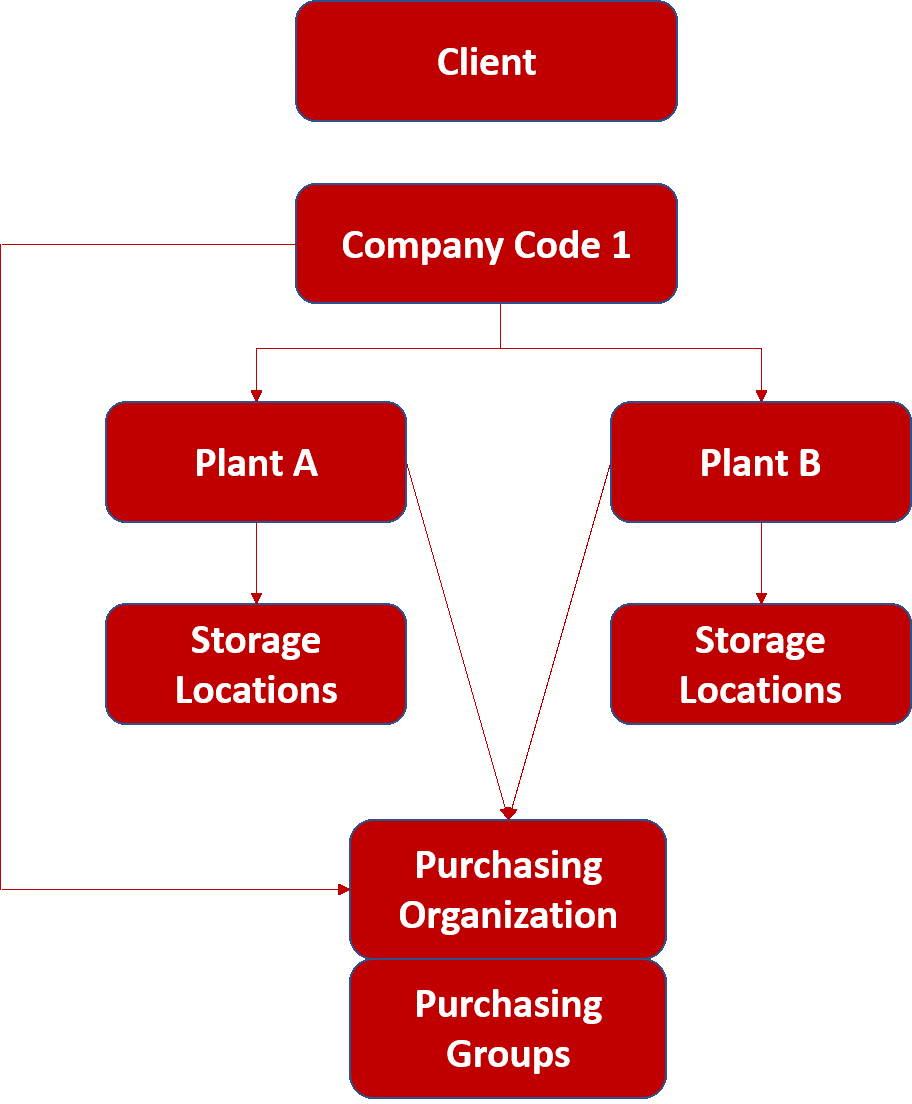
Organizational Structure of the SAP MM module
The legal and organizational structures of the firm can be represented by a number of different structures in SAP ERP. Organizational components can be arranged from the viewpoints of materials management, accounting, and human resources.
It is possible to combine different constructions. Organizational structures offer a framework within which all commercial transactions can be handled.
The MM (Materials Management) module is represented by the organizational units listed below:
Modules integrated with SAP MM
The SAP MM component interfaces with other SAP components including Production Planning (PP), Sales and Distribution (SD), Plant Maintenance (PM), Quality Management (QM), Finance (FI), Controlling (CO), and Asset Management (AM) to play an essential role in a manufacturer’s supply chain. Let’s explore and understand each of their roles in detail.
1. SAP MM with PP module: SAP MM is linked to the PP module because it handles material acquisition in accordance with production needs. Production orders, receipts, and MRPs are all integrated with it.
2. SAP MM with SD module: The SAP SD module is integrated with the MM module because it contains material generation information that is utilized when generating a sales order or when transferring the order quantity to the production line. It is connected to various industries, including delivery, stock transfer requirements, availability checks, and so on.
3. SAP MM with WM module: The SAP WM module is linked to the MM module since it maintains data on internal material storage and transportation.
4. SAP MM with FICO module: Every action made in the MM module, such as a goods receipt or an invoice reception, affects the financial operations of the company. For this reason, the FI and MM modules are interconnected. It has to do with things like material costing, vendor payment, and material assessment.
5. SAP MM with QM Module: The SAP MM module is integrated with the QM module in order to transmit relevant data to the quality control team for the purpose of establishing quality standards.
6. SAP MM with PM module : The maintenance order specifies the material or service requirements. This results in the creation of PR. MM changes this PR into a PO. A PO’s products will be delivered to Maintenance by MM. The spare parts that were held back for maintenance orders will be released by MM by the reservation number.
Prime Functionalities of SAP MM module
1. Determining the Requirements: Materials planning and control or user departments can both be used to determine what materials are needed. Purchase requisitions could be manually entered or automatically generated by the materials planning and control system.
2. Source Determination: Based on previous orders and active longer-term purchase agreements, the purchasing component aids in your identification of potential supplier sources. This speeds up drafting requests for quotations (RFQs), which, at the customer’s discretion, may be electronically transmitted to vendors via SAP EDI.
3. Vendor Selection Process and Quotation Comparison: The system’s ability to simulate pricing scenarios enables you to compare a variety of quotes. Letters of rejection can be automatically sent.
4. Purchase Order (PO) Processing: To assist you in creating a purchase order, the purchasing system incorporates information from the requisition and the bid. Like buying requisitions, you can manually create POs (Purchase Order) or have the system do it for you. Contracts and agreements with vendors (referred to as longer-term purchase agreements in the SAP System) are also supported.
5. Purchase Order (PO) Follow-Up: When you specify a reminder period, the system examines it and, if necessary, publishes expediters or reminders at predetermined intervals. Additionally, it gives you the most recent status of all purchase orders, quotes, and requisitions.
6. Inventory Management and Goods Receiving: The person in charge of goods reception can easily confirm the receipt of items by entering the PO number. Buyers can limit over- and under-delivery of ordered items by defining acceptable tolerances.
7. Verification of Invoice: The technology allows for the comparison and validation of invoices. Since the system has access to PO and goods receipt data, it notifies the accounts payable clerk of quantity and price variations. This quickens the auditing and clearing of invoices for payment procedures.
Key Components of SAP MM
1. MM – CBP (Consumption-Based Planning): Uses historical consumption data to forecast future needs and automatically generates procurement proposals when stock levels fall below reorder points.
2. MM – PUR (Purchasing): Manages procurement of materials and services, monitors vendor deliveries and payments, and identifies potential suppliers.
3. MM – SRV (External Services Management): Facilitates the management of external services, including bid invitations and invoice verification, for both planned and unplanned services.
4. MM – IV (Inventory Management): Oversees physical stock management, inventory tracking, and documentation of goods movement.
5. MM – IV (Logistics Invoice Verification): Verifies incoming invoices against purchase orders and inventory records, ensuring accuracy before passing them to financial accounting.
Benefits of SAP MM for Organizations
- Mainly improves control and oversight of inventory levels and processes.
- Reduces expenses by minimizing inventory losses, material wastage, and storage costs.
- Decreases time and labor spent on inventory maintenance and improves labor efficiency.
- Minimizes manufacturing cycle times and improves product delivery times.
- Provides clearer visibility into inventory management practices and status.
Final Thoughts
It is crucial to fully understand the many components of the system and how they work. SAP MM can be used as a simple component of a manufacturing company’s management procedures to support a continuous flow of activities from the very beginning of the production process to the very end when the client has the products.
So, folks, get in touch with our SAP Expertise to discover more about the capabilities of the SAP MM module and the advantages of ERP!
Contact us to know more!
FAQ’s
1. What is SAP Material Management (MM)?
SAP MM is a module within SAP ERP that manages material procurement and inventory functions. It helps streamline procurement processes, manage inventory, and handle vendor relations.
2. How does SAP MM benefit a company?
SAP MM improves efficiency in procurement and inventory management, reduces costs through better supplier management, and enhances accuracy in material planning.
3. How does SAP MM integrate with other SAP modules?
SAP MM integrates with modules like SAP Finance (FI) for financial transactions, SAP Sales and Distribution (SD) for sales order processing, and SAP Production Planning (PP) for production activities.
4. What is the role of SAP MM in inventory management?
SAP MM helps track inventory levels, manage stock movements, and optimize inventory levels to reduce carrying costs and avoid stockouts.